Showing posts with label Mechanical engineering facts and information. Show all posts

Tuesday, 30 January 2018

hot and cold spark plugs explained


Introduction:

In order to ignite air fuel mixture we need heat.In case of diesel engines (compression ignition engines) this head is achieved by the compression of gases.But in case of spark ignition engines we need to have an external source to ignite air fuel mixture because compression is not enough to ignite the mixture.

A spark plug is a device for delivering electric current from an ignition system to the combustion chamber of a spark-ignition engine to ignite the compressed fuel/air mixture by an electric spark, while containing combustion pressure within the engine.


There are two types of spark plug :

  • Hot Spark Plug
  • Cold Spark Plug

“Cold” spark plugs normally have a short heat flow path. This results in a very quick rate of heat transfer. Additionally, the short insulator nose found on cold spark plugs has a small surface area, which does not allow for a massive amount of heat absorption.


On the other hand, “hot” spark plugs feature a longer insulator nose as well as a longer heat transfer path. This results in a much slower rate of heat transfer to the surrounding cylinder head.

The heat range of the spark plug must be carefully selected in order to create an optimal thermal performance. If the heat range is not correct, you can expect serious trouble. Typically, the appropriate firing end temperature is  900-1,450 degrees. Below 900 degrees, carbon fouling is possible. Above it, overheating becomes an issue.

Tuesday, 26 December 2017

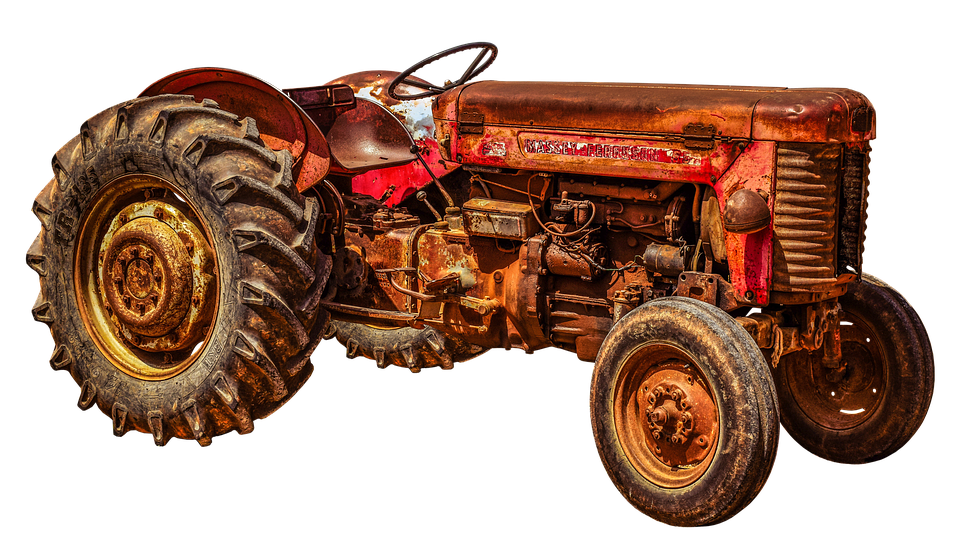
Why the back wheel in the tractor is bigger than the front wheel?


The word “tractor” is related to words like “traction” and “tractive,” from the Latin word “tractus” meaning drawing (pulling): a tractor is essentially a machine designed to pull things along, usually very slowly and surely.

Reasons for having big wheel at rear and small ones at front:


1.Grip or Traction

Farm tractors spend a lot of their life working in muddy, bumpy fields. If you’ve ever been in car that has driven over a muddy field, you will know that the car slips around on the surface of the mud, or it gets stuck. A large tyre on a tractor has much better grip pads that can ‘bite’ into the ground, as well as a large surface area that distributes weight more evenly which means the traction is a lot better. 
2.Steering
The two smaller wheels at the front have a much better steering radius which means it’s easier to turn sharp corners. This is really important to cover the maximum area of the field while carrying out different jobs like ploughing, sowing and harvesting. Being light weight and small is also really beneficial for ease of control.
3.Visibility
The large rear wheels of the tractor fix the driver’s seat at a higher elevation which ensures good visibility of the nose of the tractor and the corners of the field it ploughs.
4.Cost
Small tyres cost less than larger tyres, and therefore it is much cheaper to replace small tyres that the very expensive big ones! It’s worth noting that because the rear tyres have a much thicker tread that they don’t need to be replaced as often as the front ones.
5.Weight distribution
Having the driving axle higher above the ground means the tractor can pull more weight without the front of the tractor rising up. It works like a lever, where twice the height means twice the maximum pulling force before the tractor tips over.

Saturday, 23 December 2017

WHY TWO MOTORBIKES WITH SAME CUBIC CAPACITY BUT DIFFERENT MILEAGE!!


You might have noticed that motorbikes having same cubic capacity gives different mileage. For Example,Bajaj Platina has cubic capacity of 100 CC and it gives mileage of 104 kmpl,on the other hand Hero Splendor is also having same cubic capacity but it gives the mileage of 81kmpl.

It is mainly because the bikes like Platina has been made keeping in mind mileage.Parts are light to keep bike weight low.Carburetor is tuned to extract mileage though it puts a strain on engine which you can judge from harsh engine note.If you race it will shudder as it puts strain on engine.Also it gives Low torque, low BHP, and leaner air fuel mixture. Tyres are slim for less friction with road.All this saves you petrol but at a high maintenance cost & low resale value.High maintenance cost can be curtailed with regular servicing but if you give less petrol to engine then wear & tear will be more anyway.

Thursday, 21 December 2017

PUMP vs COMPRESSOR


DIFFERENCE BETWEEN PUMP AND COMPRESSOR

Pump and compressor both are hydraulic machines used to increase the energy of fluid. Both of these devices used in industries and for domestic work. Pump is a device which is used to move the fluid (water, liquid and gases) and increase its elevation. It is mostly used to supply fluid from
low elevation to high elevation. A compressor is a device which is a mechanical device just like pump but it increases the potential energy of fluid by compressing it in a closed container.

The main difference between pump and compressor is that the pump is used to increase kinetic energy of fluid which further increases the elevation or pressure energy of it.  It moves the fluid from one place to another. But the compressor is mostly used to increase the potential energy (pressure energy) of fluid by pressuring it into a container. It is used to compress the fluid which increases its density and pressure. There are many other differences which are described below.

Difference between pump and compressor:


Wednesday, 30 August 2017

ANTILOCK BRAKING SYSTEM

Requirement of ABS Technology:


We know that when we apply brake, it pushes the brake pad on running drum or disk. For heavy loaded vehicle we need to high braking force
to stop of slow down the vehicle. This braking force generate by some means like hydraulic pressure, Air pressure etc. When the vehicle is running and we want to stop the vehicle we push the brake pedal. Due to excessive braking causes skidding. This skidding jam the wheel but due to inertia the vehicle tends to skid on the road and it became out of control from driver. This is called locking of the wheel.

This is understood by that when we run on the floor and eventually tends to stop we slip down on it. This is exactly true for the vehicle. This type of locking is harmful for driving and may cause accident. So we have to remove it use of a new safety system. This system is called ABS.


Working of ABS Technology:


We have been already explained how locking of road wheels due to excessive braking causes skidding. Modern antilock brake systems not only cause the vehicle to stop without deviating from its straight line path, these also provide directional stability since there is no skidding of the wheels.
Skidding is avoided by releasing the braking pressure just before the wheels lock up, and then reapplying the same. These releasing and reapplying the brakes in succession is what an antilock system does and this process is called pressure modulation. This system can modulate the pressure to the brakes about 15 times per second.  The feel of brake pedal in case of ABS equipped brakes is quite similar to that of conventional power brake system.


An ABS consist of an electronic control unit, one sensor on each wheel, an electrically driven hydraulic pump and a pressure accumulator. Accumulator is used to store hydraulic fluid to maintain high pressure in the braking system and to provide residual pressure for power assisted braking. ECU monitors and controls the antilock function when required. Its function is based on inputs from the wheel speed sensors and feedback from the hydraulic unit to determine whether the ABS is operating precisely and also to decide when the antilock operation is required. In some antilock braking system, a lateral acceleration sensor is also provided to monitor the side movement of the vehicle while taking a turn. This ensures proper braking during turns also.
When the front wheels of vehicle are locked, its maneuverability is reduced, whereas in case of rear wheel locking, the vehicle stability is reduced. ABS calculates the required slip rate of the wheels accurately based on the vehicle speed and the speed of the wheels and then controls the brake fluid pressure to achieve the target slip rate. Although ABS prevents complete locking of the wheel.

ABS is manufactured by Bendix, Delco Moraine, Kelsey-Hayes Lucas Girling, Bosch etc. 

IMPORTANT TECHNICAL TERMS OF AUTOMOTIVE VEHICLES


1.)AERODYNAMIC DRAG– is the air resistance to the motion of the vehicle.This consists of profile drag, induced drag, skin friction drag, interference drag, and cooling and ventilation drag.

2.)AERODYNAMIC LIFT– is the vertical component of the resultant force caused by the pressure distribution on the vehicle body.

3.)AIR BRAKE – A braking system which uses compressed air to supply the effort required to apply brakes.

4.)BOOSTER – Device incorporated in a car system (such as brake and steering),to increase pressure output or decrease amount of effort required to operate or both.

5.)CAMBER ANGLE – The outward (positive) or inward (negative) angle of the wheel centre line to absolute vertical.

6.)CASTER ANGLE – The rearward (positive) or forward (negative) angle of the steering axis to absolute vertical.

7.)CLUTCH PEDAL – A pedal in the drivers compartment that operates the clutch.

8.)CLUTCH SLIPPAGE – A condition in which the engine over revs during shifting or acceleration.

9.)DUAL BRAKE SYSTEM – Tandem or dual master cylinder to provide a brake system that has two separate hydraulic systems, one operating the front brakes, the other operating the rear brakes.

10.)EPICYCLIC GEAR– In the epicyclic gearing, at least one gear not only rotates about its own axis, but also rotates about some other axis.

Monday, 24 July 2017

MEANING OF RTR IN TVS APACHE


RTR in Apache means Racing Throttle Response .

Throttle response or vehicle responsiveness is a measure of how quickly a vehicle's prime mover, such as an internal combustion engine, can increase its power output in response to a driver's request for acceleration. Throttles are not used in diesel engines, but the term throttle can be used to refer to any input that modulates the power output of a vehicle's prime mover. Throttle response is often confused with increased power but is more accurately described as time rate of change of power levels.


Formerly, gasoline/petrol engines exhibited better throttle response than diesel engines. This results from higher specific power output and higher maximum engine power, as well as the fact that lower-powered diesel engines were disproportionately heavier. Recently diesel engines became able to outperform similar-sized petrol engines. Most naturally aspirated gasoline engines have better responsiveness than supercharged or turbocharged engines for engines with similar peak power outputs. However, factors such as improper maintenance, fouled spark plugs or bad injectors can reduce throttle response. Diesel engines are less likely to lose throttle response, since their power comes from self-igniting fuel. Older diesel engines directly connect the accelerator pedal to the injection pump resulting in instant response.

Several tuning factors can affect engine responsiveness.Throttle response in manual cars can be enhanced by dropping to a lower gear before accelerating. This action is often used in smaller cars to aid in overtaking.