Tuesday, 26 December 2017

GRINDING vs POLISHING


Grinding is an abrasive cutting action to meet dimensional accuracy and at same time smoother surface.Grinding removes saw marks and levels and cleans the specimen surface.Grinding uses fixed abrasives—the abrasive particles are bonded to the paper or platen—for fast stock removal.

The main purpose of the grinding step is to remove damage from cutting and to remove material approaching the area of interest.


Polishing is an super finishing operation which uses very fine abrasive just to improve roughness .Polishing removes the artifacts of grinding but very little stock.Polishing uses free abrasives on a cloth; that is, the abrasive particles are suspended in a lubricant and can roll or slide across the cloth and specimen.


The main purpose of polishing is to prepare specimen for microstructural analysis. It is the step which is required to completely eliminate previous damage.


basic definitions of fluid mechanics


Density (mass density): The mass per unit volume is defined as density. The unit used is kg/m3.The measurement is simple in the case of solids and liquids. In the case of gases and vaporous is rather involved. The symbol used is ρ. The characteristic equation for gases provides ameans to estimate the density from the measurement of pressure, temperature and volume.


Specific Volume: The volume occupied by unit mass is called the specific volume of the material. The symbol used is v, the unit being m3/kg. Specific volume is the reciprocal of density.In the case of solids and liquids, the change in density or specific volume with changes in pressure and temperature is rather small, whereas in the case of gases and vapours, density will change significantly due to changes in pressure and/or temperature.

Weight Density or Specific Weight: The force due to gravity on the mass in unit volume is defined as Weight Density or Specific Weight. The unit used is N/m3 .

Specific Gravity or Relative Density:  The ratio of the density of the fluid to the density of water—usually 1000 kg/m3 at a standard condition—is defined as Specific Gravity or Relative Density δ of fluids. This is a ratio and hence no dimension or unit is involved.

Compressible fluid -If the density of a fluid varies significantly due to moderate changes in pressure ortemperature, then the fluid is called compressible fluid.

Incompressible fluid-If the change in density of a fluid is small due to changes in temperature and or pressure, then the fluid is called incompressible fluid.

Buoyant force- If an object is immersed in or floated on the surface of fluid under static conditions a force acts on it due to the fluid pressure. This force is called buoyant force.


Archimedes principle -Archimedes principle can be stated as (i) a body immersed in a fluid is buoyed upby a force equal to the weight of the fluid displaced and (ii) a floating body displaces its own weight of the liquid in which it floats.

Reynolds number -Reynolds number is the ratio of inertia force to viscous force. As inertia force increases Reynolds number increases and the flow becomes turbulent.

Multiple Choice Questions (MCQ) with Answers on Engine Lubrication System


1-Lubricating oil
(A) Minimizes wear in moving parts
(B) Helps in keeping the parts cool
(C) Washes away and carries away dirt
(D) All of the above
(Ans: D)

2-Viscosity index (VI) is a measure for the change of viscosity with change in
(A) Temperature
(B) Pressure
(C) Volume
(D) All of the above
(Ans: A)

3-The following type of Lubrication system is used in two stroke engines
(A) Petroil (mist) system
(B) Wet sump system
(C) Dry sump system
(D) All of the above
(Ans: D)

4-In the following system, lubricating oil is carried in separate tanks from where it is fed to the engine
(A) Mist lubrication system
(B) Wet sump system
(C) Dry sump system
(D) Splash system
(Ans: C)

5-The following type of Lubrication system is used in Aircraft Engines
(A) Mist lubrication system
(B) Wet sump system
(C) Dry sump system
(D) Splash system
(Ans: C)

6-The following type(s) of Oil pump(s) is (are) used in Engine Lubrication system
(A) Gear type
(B) Rotor type
(C) Plunger type
(D) All of the above
(Ans: D)

7-The following is (are) oil pressure gauge(s)
(A) Pressure expansion type
(B) Electric type
(C) both (A) and (B)
(D) None of the above
(Ans: C)

8-The purpose of crankcase ventilation is to
(A) remove harmful particles from the engine
(B) provide proper lubrication to the engine
(C) provide air for combustion to the engine
(D) all of the above
(Ans: A)

9-The following part(s) is(are) lubricated by splash system
(A) Piston and piston rings
(B) Tappets
(C) Cams on camshaft
(D) All of the above
(Ans: D)

10-The following part is not lubricated by Pressure feed system
(A) Timing gears
(B) Valve rods and Push rods
(C) Rocker arms
(D)  Main bearings of crankshaft
(Ans: B)

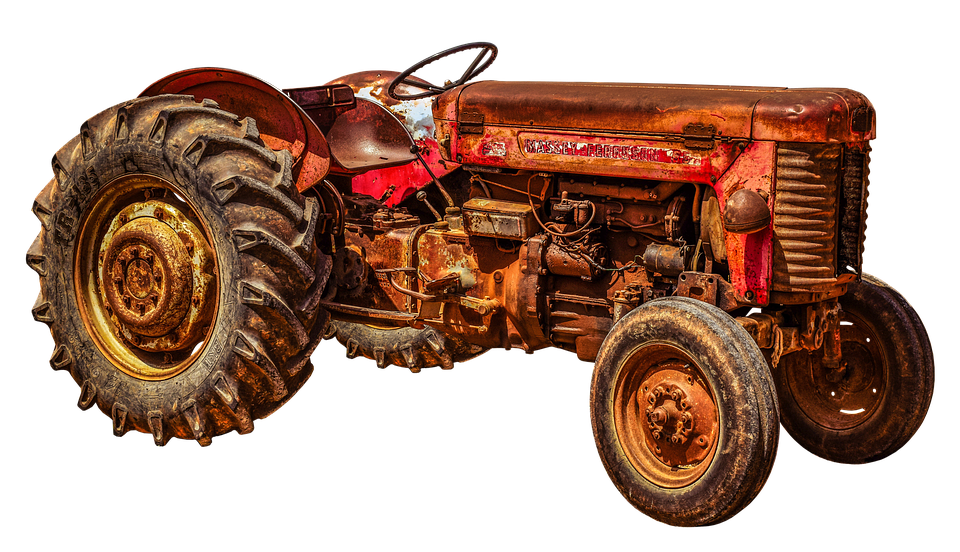
Why the back wheel in the tractor is bigger than the front wheel?


The word “tractor” is related to words like “traction” and “tractive,” from the Latin word “tractus” meaning drawing (pulling): a tractor is essentially a machine designed to pull things along, usually very slowly and surely.

Reasons for having big wheel at rear and small ones at front:


1.Grip or Traction

Farm tractors spend a lot of their life working in muddy, bumpy fields. If you’ve ever been in car that has driven over a muddy field, you will know that the car slips around on the surface of the mud, or it gets stuck. A large tyre on a tractor has much better grip pads that can ‘bite’ into the ground, as well as a large surface area that distributes weight more evenly which means the traction is a lot better. 
2.Steering
The two smaller wheels at the front have a much better steering radius which means it’s easier to turn sharp corners. This is really important to cover the maximum area of the field while carrying out different jobs like ploughing, sowing and harvesting. Being light weight and small is also really beneficial for ease of control.
3.Visibility
The large rear wheels of the tractor fix the driver’s seat at a higher elevation which ensures good visibility of the nose of the tractor and the corners of the field it ploughs.
4.Cost
Small tyres cost less than larger tyres, and therefore it is much cheaper to replace small tyres that the very expensive big ones! It’s worth noting that because the rear tyres have a much thicker tread that they don’t need to be replaced as often as the front ones.
5.Weight distribution
Having the driving axle higher above the ground means the tractor can pull more weight without the front of the tractor rising up. It works like a lever, where twice the height means twice the maximum pulling force before the tractor tips over.

Saturday, 23 December 2017

WHY TWO MOTORBIKES WITH SAME CUBIC CAPACITY BUT DIFFERENT MILEAGE!!


You might have noticed that motorbikes having same cubic capacity gives different mileage. For Example,Bajaj Platina has cubic capacity of 100 CC and it gives mileage of 104 kmpl,on the other hand Hero Splendor is also having same cubic capacity but it gives the mileage of 81kmpl.

It is mainly because the bikes like Platina has been made keeping in mind mileage.Parts are light to keep bike weight low.Carburetor is tuned to extract mileage though it puts a strain on engine which you can judge from harsh engine note.If you race it will shudder as it puts strain on engine.Also it gives Low torque, low BHP, and leaner air fuel mixture. Tyres are slim for less friction with road.All this saves you petrol but at a high maintenance cost & low resale value.High maintenance cost can be curtailed with regular servicing but if you give less petrol to engine then wear & tear will be more anyway.

Thursday, 21 December 2017

PUMP vs COMPRESSOR


DIFFERENCE BETWEEN PUMP AND COMPRESSOR

Pump and compressor both are hydraulic machines used to increase the energy of fluid. Both of these devices used in industries and for domestic work. Pump is a device which is used to move the fluid (water, liquid and gases) and increase its elevation. It is mostly used to supply fluid from
low elevation to high elevation. A compressor is a device which is a mechanical device just like pump but it increases the potential energy of fluid by compressing it in a closed container.

The main difference between pump and compressor is that the pump is used to increase kinetic energy of fluid which further increases the elevation or pressure energy of it.  It moves the fluid from one place to another. But the compressor is mostly used to increase the potential energy (pressure energy) of fluid by pressuring it into a container. It is used to compress the fluid which increases its density and pressure. There are many other differences which are described below.

Difference between pump and compressor:


Wednesday, 20 December 2017

TERMS OF INTERNAL COMBUSTION ENGINES


1.)AFTER COOLER – A device used on turbocharged engines to cool air which has undergone compression.

2.)ATDC – After TDC, After top dead centre.

3.)AIR CLEANER – A device mounted on the intake manifold for filtering out unwanted solid impurities such as dirt and dust from air that is being drawn into the engine cylinder through the inlet manifold.

4.)AIR COOLED ENGINE – An engine that is cooled by passage of air around the cylinder, not by passage of a liquid through water jackets.

5.)AIR STANDARD CYCLE – A standard cycle of reference by which the performance of the different internal combustion engines may be compared, and their relative efficiencies calculated.

6.)AKROYD ENGINE – The first compression ignition engine, patented by Akroyd Staurt in 1890.

7.)ALUMINIUM CYLINDER BLOCK – An engine cylinder block cast from aluminium or aluminium alloy, and which usually has cast iron sleeves installed for use as cylinder bores.

8.)ANTIFREEZE – A chemical, added to the coolant (usually ethylene glycol) to lower its freezing point and thereby prevent the coolant from freezing in cold weather.

9.)ANTI ICING SYSTEM – A carburettor unit designed to prevent formation of ice on a surface or in a passage.

10.)ARTICULATED CONNECTING ROD – The auxiliary connecting rods of a radial engine, which work on pins carried by the master rod instead of on the main crankpin. Also called LINK RODS.

11.)BACK PRESSURE – A pressure exerted by a fluid contrary to the pressure producing the main flow. For example, pressure in the exhaust manifold, the higher the back pressure, greater is the resistance to flow of exhaust gases through the exhaust system. This lowers volumetric efficiency.

12.)CLEARANCE VOLUME – The volume remaining above the piston when the piston is at TDC.

13.)COMBUSTION CHAMBER – The space at the top of the cylinder and in the cylinder head or piston or both, in which combustion of fuel and charge takes place. The space enclosed by the piston, when the piston is at TDC.

14.)COMPRESSION RATIO – The ratio between the total volume of the cylinder when the piston is at BDC and the volume when the piston is at TDC.

15.)CONNECTING ROD – The rod made of steel or aluminium alloy usually having an I beam cross-section. A piston pin connects the connecting rod and the piston.